Effect of Accessories on Vehicle Aerodynamics — CFD Study
OVERVIEW
Modelled a Koenigsegg Jesko Absolut in SolidWorks and ran ANSYS Fluent CFD (k-ε, 1,098,393 elements) across spoiler, wing, diffuser, and fin configurations at 150 km/h. The spoiler + diffuser combination cut drag coefficient 16.53% below baseline while diffusers reduced drag in every tested case; wings traded +27.8% drag for significant downforce (Cl −0.115 with diffuser). Findings drawn from pressure contours and velocity streamline analysis.
APPROACH
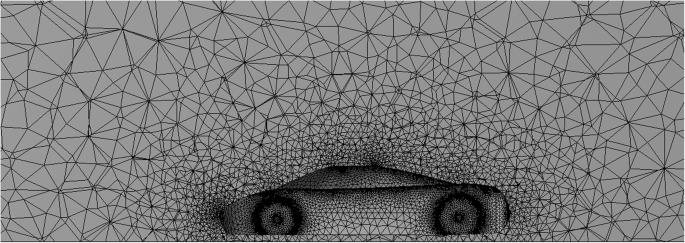
The question was simple: which aero add-ons actually reduce drag on a high-performance car, and what do the others cost you? I modeled the body of a Koenigsegg Jesko Absolut in SolidWorks from its blueprints (4320 × 1990 × 1090 mm, 90 mm ground clearance). Then I built eight versions of it: the stock body, each of four add-ons on its own (lip spoiler, rear wing, rear diffuser, fins), and three combinations with the diffuser. All eight ran through ANSYS Fluent under the same conditions, so the only thing changing between runs was the geometry.
KEY DESIGN DECISIONS
Every case ran under the same conditions. The car sat in a virtual wind tunnel 12 × 4 × 8 m. Air entered at 150 km/h — the speed where the add-ons start to matter — and the ground moved at the same speed to mimic a real road instead of a stationary floor. The outlet was open to ambient pressure. The car's frontal area of 1.98 m² blocks about 6% of the tunnel's cross-section, so the walls don't distort the flow much.
Rear wing. 1700 mm span at a 33.9° angle of attack, to test the classic trade of downforce for drag.
Diffuser. 1000 mm long, angled at 17°, with 7.5 mm blades. A steeper angle risks the flow separating and adding drag; a shallower one does very little.
Fins. 25 mm thick, placed at the mid-rear like the real Jesko Absolut's.
Mesh and turbulence model. The mesh had about 1.1 million elements, finer close to the car's surface. I used the standard k-ε turbulence model with wall functions because it converges reliably and is cheap to run on a student setup. Solutions were run to a residual of 1e-4.
RESULTS
| Configuration | Cd | Change in drag | Cl |
|---|---|---|---|
| Baseline | 0.344 | — | 0.718 |
| Spoiler + diffuser | 0.287 | −16.5% | 0.317 |
| Spoiler | 0.292 | −15.2% | 0.318 |
| Diffuser | 0.334 | −2.8% | 0.688 |
| Fins | 0.339 | −1.6% | 0.617 |
| Rear wing | 0.477 | +38.5% | −0.050 |
| Wing + diffuser | 0.472 | +37.0% | −0.115 |
The spoiler did most of the work. On its own it cut drag by 15% and lift by 56%, because it shrinks the low-pressure wake behind the car, as the velocity contours show. Adding the diffuser to it gave the best result overall: 16.5% less drag, which works out to about 121 N less at 150 km/h.
The rear wing was the only add-on that produced real downforce. The price was 38% more drag and the largest recirculation zone of any case. The diffuser lowered drag in every combination it was added to.
LESSONS
An add-on's job is not always lower drag. The fins cut drag by less than 2%, yet Koenigsegg puts them on its lowest-drag car. Their purpose is stability at high speed, which a drag-and-lift study can't measure. What a part is for decides how you should judge it.
Drag and downforce pull against each other. The wing made the car worse for top speed and better for cornering. The right choice depends on what the car is being designed to do, not on one number.
Look at the flow, not just the coefficients. The streamlines and velocity contours explained every number in the table. The less the flow separated at the rear, the lower the drag.
What I'd do differently. I simulated only at 150 km/h and scaled the forces to 70 and 300 km/h, which assumes Cd stays constant with speed. I'd run each speed separately. I'd also run a mesh-independence study, lengthen the domain so the wake has room to develop, and try k-ω SST, which predicts flow separation better. That matters here because separation is exactly what the add-ons change.